
by Sarah Mayfield, M.Ed., NCC, CT
“Time heals all wounds.”
Nope!
Three thoughts:
- I like the term “griever” vs. “bereaved” for those who have experienced the death of a loved one. While both terms are technically correct, the former suggests personal agency and the latter implies static circumstance. Similar to internal vs. external locus of control.
- Let’s be real, time does very little other than tick. It’s the griever showing up every day (hour, minute) who builds those grief muscles. It’s the griever who repeatedly sits with the overwhelming intensity of emotions. It’s the griever who repeatedly processes the barrage of painful thoughts.
- Grievers learn a heck of a lot when engaging grief. Emotions, cognitions, physical symptoms, coping strategies, supports, relationship differences, patterns/lack of patterns, role changes, meaning-making, continuing bonds… the list goes on! Dare I say that, amidst hell, grievers grow?
Enter Tonkin’s “Growing Around Grief.”
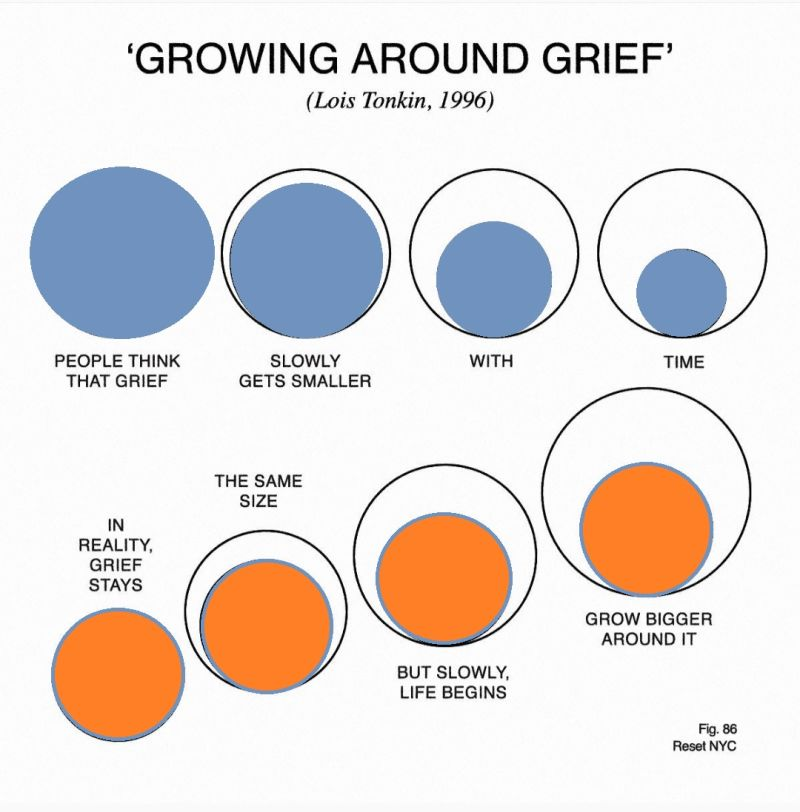
I look at this visual 7 years after my son’s death and, you know, I can say it makes sense.
My grief did not (and does not) grow smaller.
My grief has not disappeared.
My wounds are not healed.
1. It’s the griever
2. Who builds the grief muscles
3. And learns & grows around grief
Keep your day job, Time!
Resources
Tonkin, L. (1996). Growing around grief—another way of looking at grief and recovery. Bereavement Care, 15(1), 10.
 Full Circle Grief Center